

Best Ultralytics Alternatives in 2026
Table of contents
Share blog post


This article reviews alternatives to Ultralytics for computer vision projects in 2026, covering options for object detection, instance segmentation, tracking, and multimodal AI. It compares licensing terms, deployment trade-offs, and performance considerations across open-source libraries like RF-DETR, Detectron2, and YOLOX, as well as managed platforms like Roboflow and Supervisely. Useful for teams weighing commercial license costs, hardware constraints, or research flexibility against the convenience of the Ultralytics ecosystem.

Share blog post
Ultralytics remains a popular choice for YOLO-based computer vision, but licensing costs and deployment constraints push many teams to look elsewhere. This guide breaks down alternatives across open-source frameworks, managed platforms, and specialized tools so you can pick the right fit for your project.

The 10 Best Ultralytics Alternatives in 2026
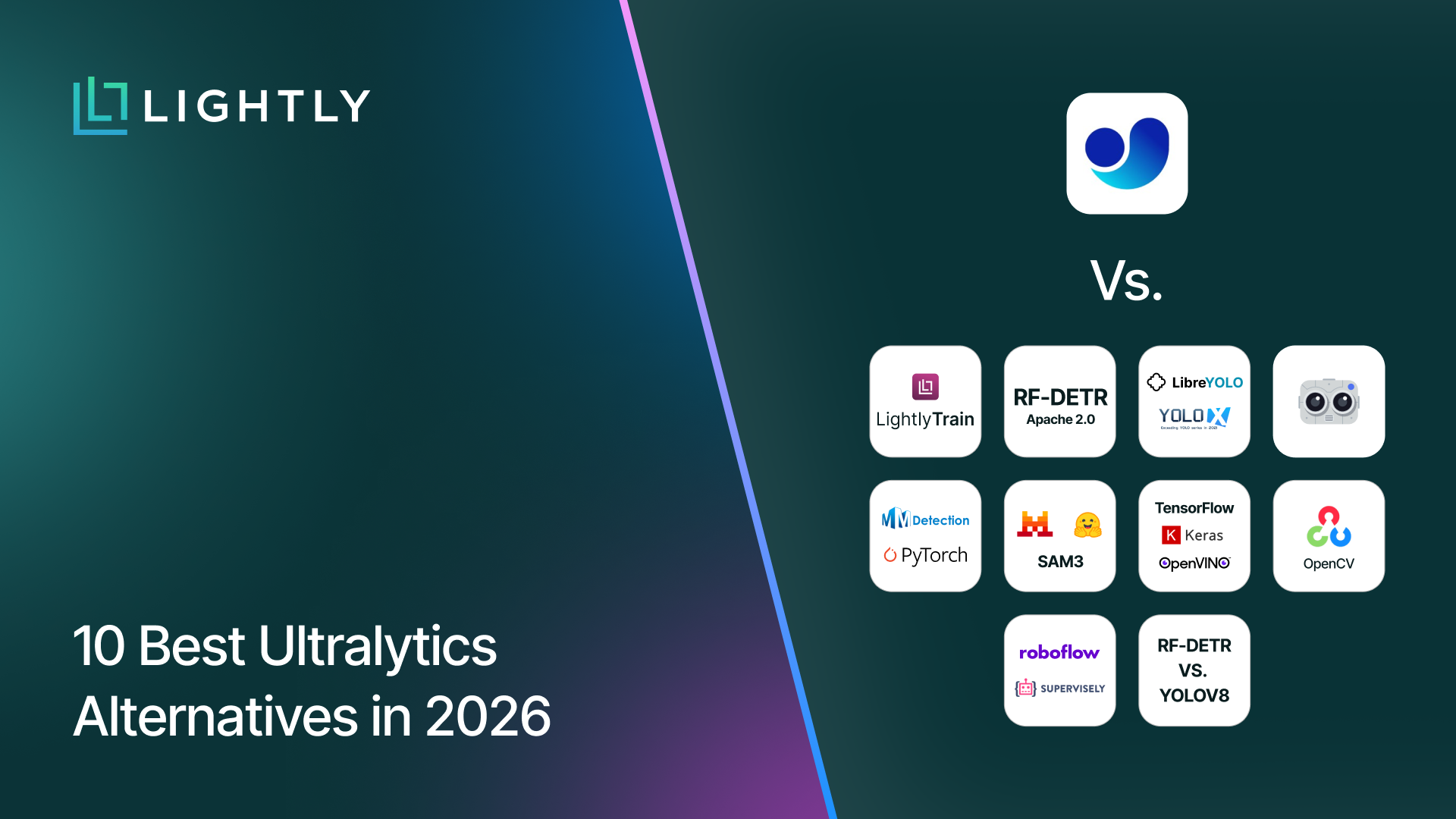
Below are 10 alternatives worth considering in 2026 - open-source frameworks, managed platforms, and data-centric tools. Jump straight to any of them:
- LightlyTrain — Best for self-supervised pretraining and distillation when labels are limited.
- RF-DETR — Best transformer-based object detector under Apache 2.0.
- LibreYOLO & YOLOX — Best free, MIT/Apache YOLO-style baselines.
- Detectron2 — Best for instance segmentation and research-grade flexibility.
- MMDetection & TorchVision — Best for modular experimentation.
- Hugging Face, Mistral & SAM 3 — Best for multimodal and zero-shot.
- TensorFlow, KerasCV & OpenVINO — Best for GCP, mobile, and Intel deployment.
- OpenCV & tracking tools — Best for real-time tracking on a budget.
- Roboflow & Supervisely — Best managed platforms.
- RT-DETRv2 vs. YOLOv8 — Performance benchmark.
What is replacing YOLO?
Nothing fully replaces YOLO. RF-DETR and RT DETR are strong for object detection, Detectron2 is strong for instance segmentation, and Hugging Face is better for multimodal AI. The best AI for computer vision depends on your project, GPU, image collection, and performance target.
Is YOLO26 better than YOLOv8?
YOLO26 is newer than YOLOv8 and it is the current state-of-the-art model from Ultralytics for many edge/production uses. However, YOLOv8 is so far still more common, easier to train, and well documented in a GitHub repo. Also, YOLOv8 is usually better than YOLOv7 for ease of deployment, but YOLOv7 still matters when people want other models outside the Ultralytics ecosystem.
See Lightly in Action
Curate and label data, fine-tune foundation models — all in one platform.
Book a Demo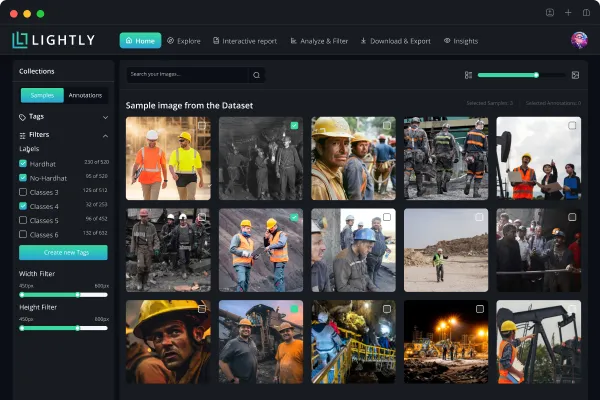
1. LightlyTrain for AI model development
Best for: Teams whose real bottleneck is data quality, not model architecture - especially when labeled data is limited or production data drifts from public benchmarks.
- Self-supervised pretraining with DINOv3-style representation learning on your unlabeled data, before you commit to labeling.
- Backbone-agnostic. Works with YOLO, RT-DETR, ViT, ResNet, and custom architectures.
- Knowledge distillation to compress large foundation models into deployable student models.
- Fine-tuning workflows built on top of the pretrained backbones.
Licensing: AGPL-3.0 for open-source use, commercial license available. Note that downstream Ultralytics models trained with LightlyTrain may still require their own commercial license.
💡 Pro Tip: See LightlyTrain in action below.
2. RF-DETR for object detection in computer vision
Best for: Object detection where overlapping objects, crowded scenes, or complex surveillance video make CNN-based YOLO less reliable.
- Transformer architecture with strong COCO mAP performance.
- Apache 2.0 license on most variants — significantly less restrictive than Ultralytics' AGPL.
- Handles occlusion well thanks to global attention.
- Drop-in alternative for many YOLO use cases when accuracy matters more than raw speed.
Licensing: Apache 2.0 (verify variant — larger models occasionally ship under different terms).
3. LibreYOLO and YOLOX
Best for: Teams that want an Ultralytics-like API without the AGPL or commercial license.
LibreYOLO
- MIT license — most permissive option on this list.
- Familiar API:
train(),predict(),val(),export(). - Easy migration from Ultralytics-based projects.
YOLOX
- Apache 2.0 license.
- Anchor-free design.
- Strong baseline, well-maintained GitHub repo.
💡 Pro Tip: Both are great starting points, but performance per parameter tends to lag behind YOLO11/YOLO26. Pair either with LightlyTrain pretraining to close that gap without paying for an Ultralytics license.
4. Detectron2 for instance segmentation
Best for: Teams that need pixel-level masks, panoptic segmentation, or maximum flexibility for research experiments.
- Mask R-CNN, Faster R-CNN, RetinaNet, Cascade R-CNN — all first-party implementations.
- Panoptic segmentation and DensePose out of the box.
- Maintained by Meta AI with active community contributions.
- Apache 2.0 license.
Trade-off: Steeper learning curve than Ultralytics. Expect to spend time on config files and registry patterns.
5. MMDetection and TorchVision
Best for: Researchers or engineers who want to compare architectures or build custom training loops.
MMDetection
- 50+ object detection and segmentation architectures in one library.
- Config-based, easy to swap backbones, necks, and heads.
- Great for benchmarking across architectures on your own data.
TorchVision
- The de-facto PyTorch library for pretrained models and image transforms.
- Clean API for writing your own training loop.
- BSD-licensed.
💡 Pro Tip: These are libraries, not platforms — you still need a data curation layer. LightlyStudio plugs in cleanly to surface the right training data before you run experiments.
6. Hugging Face, Mistral, and SAM 3
Best for: Teams pushing beyond bounding boxes into vision-language models, zero-shot segmentation, or multimodal pipelines.
Hugging Face Transformers
- Massive library of pretrained vision and vision-language models.
- Licenses vary per model — most are Apache 2.0, some are not. Always check.
Mistral
- Primarily LLM-focused but expanding into vision-language tasks.
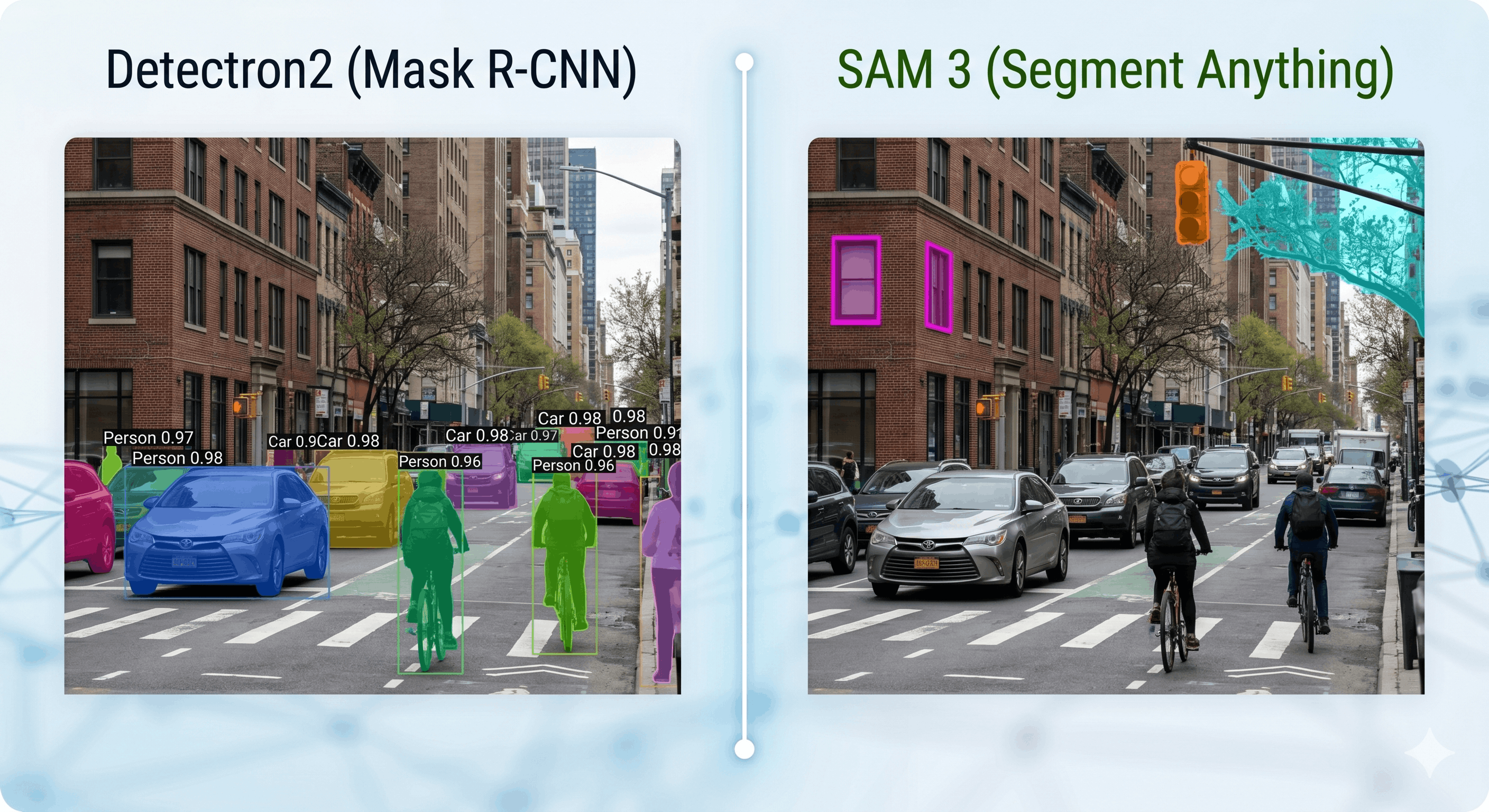
SAM 3 (Segment Anything Model 3)
- Zero-shot, prompt-based segmentation.
- Great companion to a YOLO-style detector when you also need masks.
💡 Pro Tip: SAM 3 isn't a YOLO replacement — it's a complement. Use a fast detector (RF-DETR, YOLO11) for bounding boxes, then SAM 3 for precise masks when you need them.
7. TensorFlow, KerasCV, and OpenVINO
Best for: Teams already locked into the Google Cloud / mobile / Intel hardware ecosystems.
TensorFlow Object Detection API + KerasCV
- First-class GCP integration and TensorFlow Lite export for mobile.
- Enterprise-grade tooling.
OpenVINO
- Intel's inference optimizer — significant speedups on Intel CPUs and integrated GPUs.
- Great for edge devices where you can't use NVIDIA hardware.
💡 Pro Tip: Pick by where you deploy: GCP/mobile → TF stack, Intel edge → OpenVINO. For NVIDIA GPUs, you'll usually get better results with PyTorch-based options.
8. OpenCV and open-source tracking tools
Best for: Teams who need multi-object tracking on top of a detector, without paying for a managed platform.
- OpenCV — 2,500+ optimized CV algorithms, the foundation of most real-time pipelines.
- MediaPipe — Google's ready-to-use solutions for mobile and web.
- ByteTrack — high-performance multi-object tracking, pairs well with any detector.
- DeepSORT — appearance-based tracking, robust across occlusions.
- Norfair — lightweight Python tracker that's easy to plug in.
💡 Pro Tip: Don't conflate detection and tracking. A weak detector + great tracker often beats the reverse. Spend your time on detection quality first, then layer ByteTrack or Norfair on top.
9. Roboflow and Supervisely platforms
Best for: Teams that want a complete annotate → train → deploy workflow without building it themselves.
Roboflow
- One-click YOLO training and hosted inference endpoints.
- Strong dataset versioning and augmentation tooling.
- Good for small teams that want to ship fast.

Supervisely
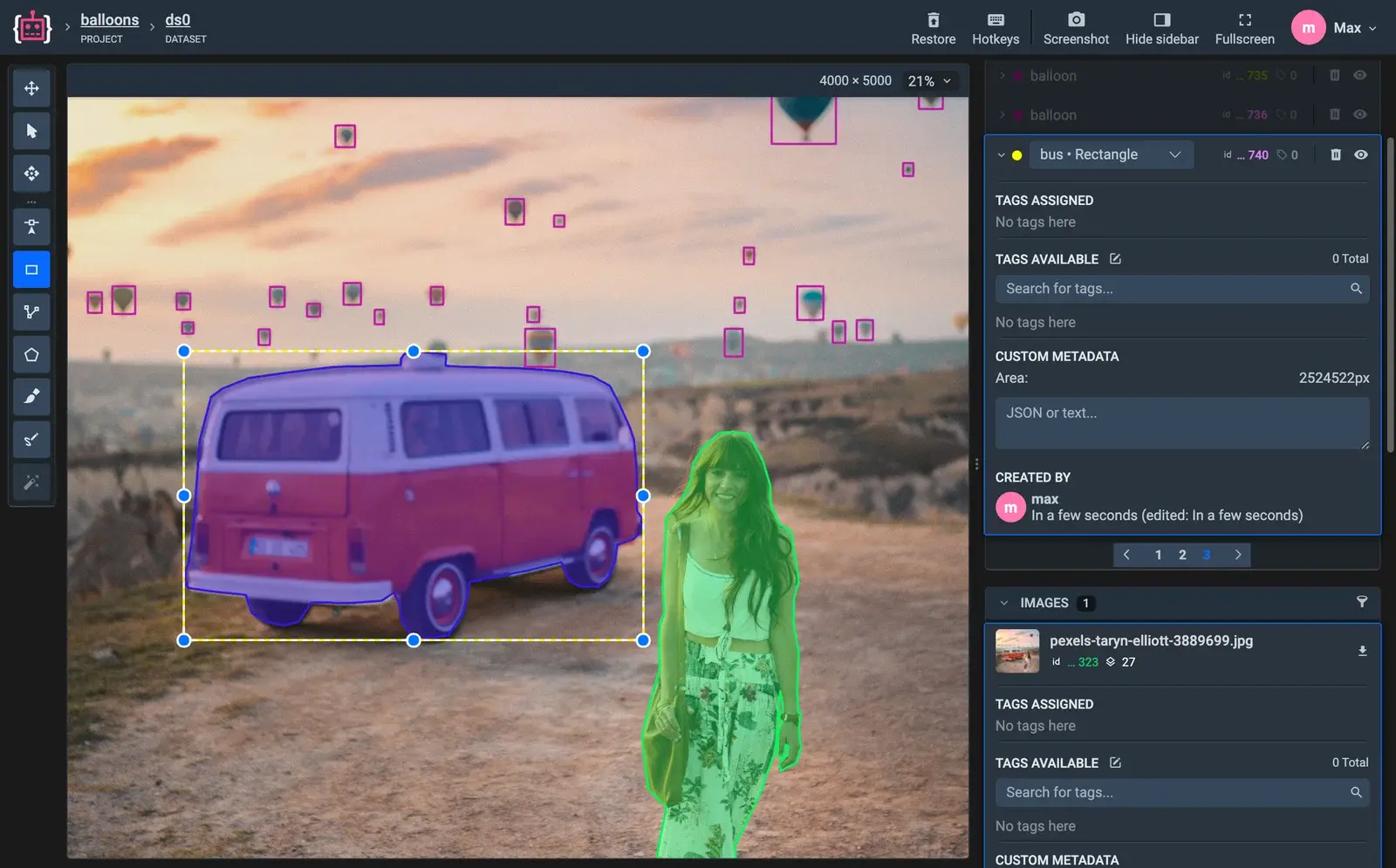
- Modular platform with an app ecosystem for labeling, training, and deployment.
- More flexible than Roboflow for custom workflows.
- Better for teams with specialized data (medical, satellite, 3D).
Trade-off: Both cost more than self-hosting, and you're locked into their workflows. Migrate-out friction is real.
10. RTDETRv2 vs YOLOv8 performance
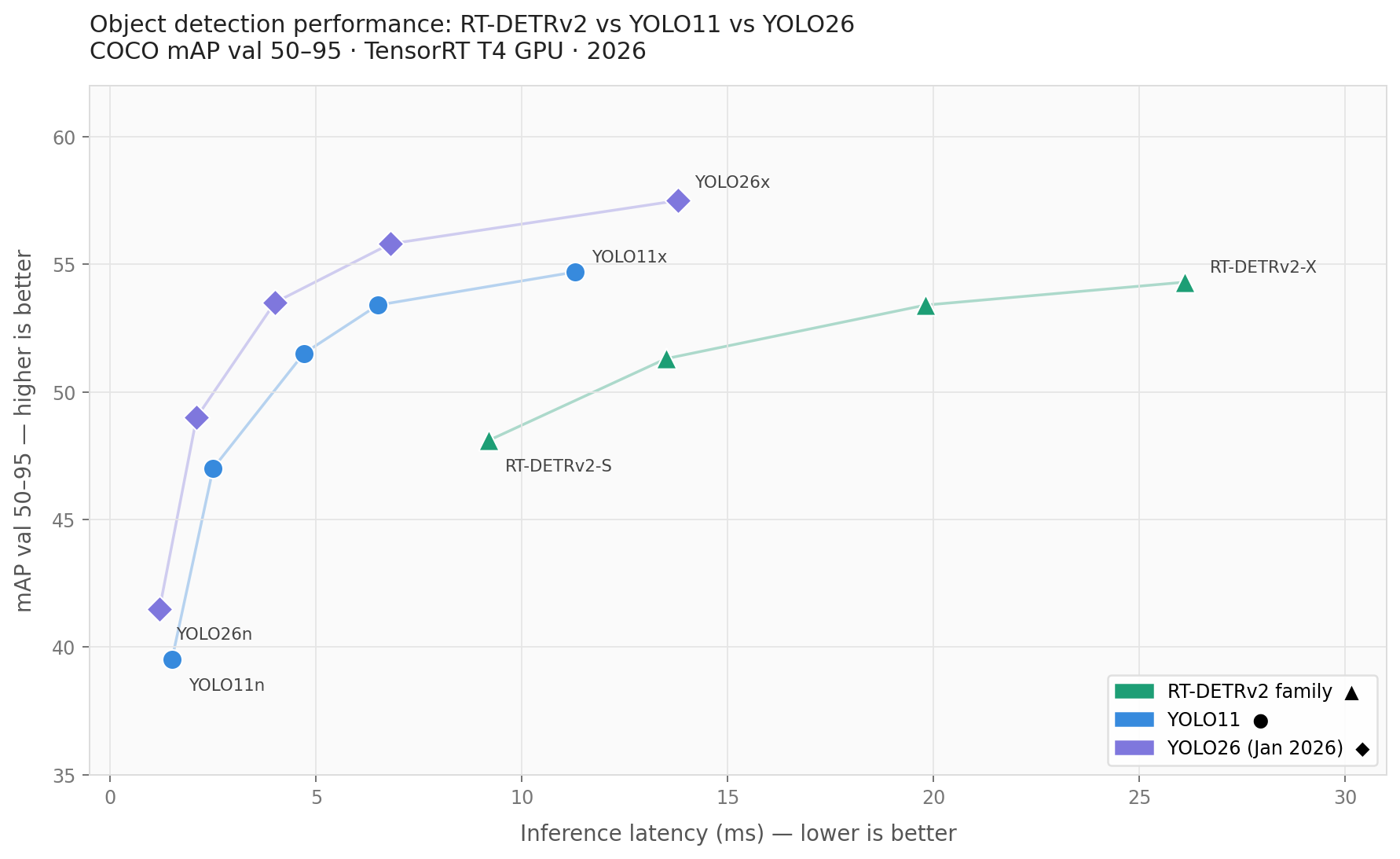
RT-DETRv2 achieves a strong 54.3 mAP (val 50-95) on COCO at 640px, outperforming the older YOLOv8-x (53.9 mAP) while using a hybrid CNN-transformer architecture well-suited to complex scenes with overlapping or crowded objects.
However, newer Ultralytics models have closed or surpassed this gap with better efficiency:
- YOLO11x: 54.7 mAP — higher accuracy than RT-DETRv2-x, with significantly fewer parameters (~56.9M vs. ~76M) and lower FLOPs (~194.9B vs. ~259B). Much faster inference on TensorRT (e.g., small/medium variants often under 5ms on T4).
- YOLO26x (latest flagship, released Jan 2026): ~57.5 mAP (with strong end-to-end/NMS-free scores around 56.9), even better efficiency, up to 43% faster CPU inference in smaller variants, and optimized for edge/low-power deployments with NMS-free end-to-end design.
Key practical takeaways (beyond single mAP):
- YOLO models (especially YOLO11 and YOLO26) generally deliver superior speed-efficiency trade-offs for real-time applications, easier deployment (broad export support), and lower resource use.
- RT-DETRv2 shines in scenarios where transformer global attention helps with complex/occluded scenes, but it typically has higher computational cost and memory demands.
- Always test on your target hardware/dataset: A single COCO mAP does not capture real-world factors like latency on your GPU/CPU/edge device, small-object performance, power consumption, or post-processing overhead (YOLO26’s NMS-free mode is a big advantage here).
How to choose alternatives
Most teams that move off Ultralytics do it for one of three reasons: licensing cost, deployment constraints, or data quality. Match the reason to the tool:
- License is the issue → RF-DETR (Apache 2.0), YOLOX (Apache 2.0), or LibreYOLO (MIT).
- You need pixel-perfect masks → Detectron2 or SAM 3.
- You want a managed workflow → Roboflow (fast onboarding) or Supervisely (more flexible).
- You want research flexibility → MMDetection, TorchVision, or Hugging Face.
- Your data is the bottleneck → LightlyTrain for pretraining and distillation, LightlyStudio for curation and labeling.
- You need to deploy on specific hardware → OpenVINO (Intel), KerasCV/TFLite (mobile/GCP).
Whichever direction you pick, validate it on your own data and target hardware before committing. COCO mAP is a starting point, not the answer.
If you want to improve dataset quality, pretraining, or labeling workflows, you can get started with LightlyStudio in a few minutes.
Stay ahead in computer vision
Get exclusive insights, tips, and updates from the Lightly.ai team.

.png)
.png)