


The 10 Best Encord Alternatives in 2026: A Practical Guide for ML Teams
Table of contents
Share blog post



The data labeling landscape in 2026 is more competitive than ever, with Meta's Scale AI deal and rising enterprise pricing pushing many ML teams to rethink their stack. This guide compares the 10 most credible Encord alternatives - and helps you pick one based on your real bottleneck: annotation, curation, or training.

Share blog post
The data labeling landscape in 2026 is more competitive and more nuanced than ever. With enterprise pricing, setup complexity, and the Meta–Scale AI deal reshaping vendor decisions, many ML teams are actively re-evaluating their annotation and curation stack. Here's what you need to know before choosing an Encord alternative.

The 10 Best Encord Alternatives in 2026: A Practical Guide for ML Teams
Encord has built a serious enterprise labeling platform - Annotate, Index, and Active combine image annotation, dataset curation, and model evaluation in one place. But comprehensive and right-for-your-team aren't the same thing. Teams that evaluate Encord usually bump into enterprise-tier pricing, weeks of setup, no open-source path, and a heavy feature surface if they only need one piece. Meta's ~$14.3B investment for a 49% stake in Scale AI in 2025 has also pushed many teams to rebalance their vendor mix.
This guide walks through the ten most credible Encord alternatives in 2026, with a quick comparison table and a use-case-based recommendation at the end. Jump to any of them:
See Lightly in Action
Curate and label data, fine-tune foundation models — all in one platform.
Book a Demo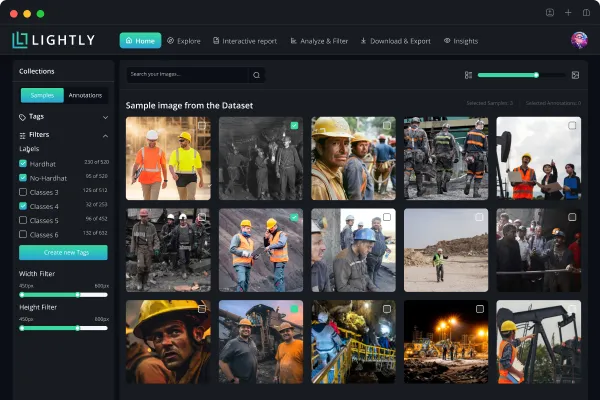
1. Lightly (LightlyStudio + LightlyTrain)
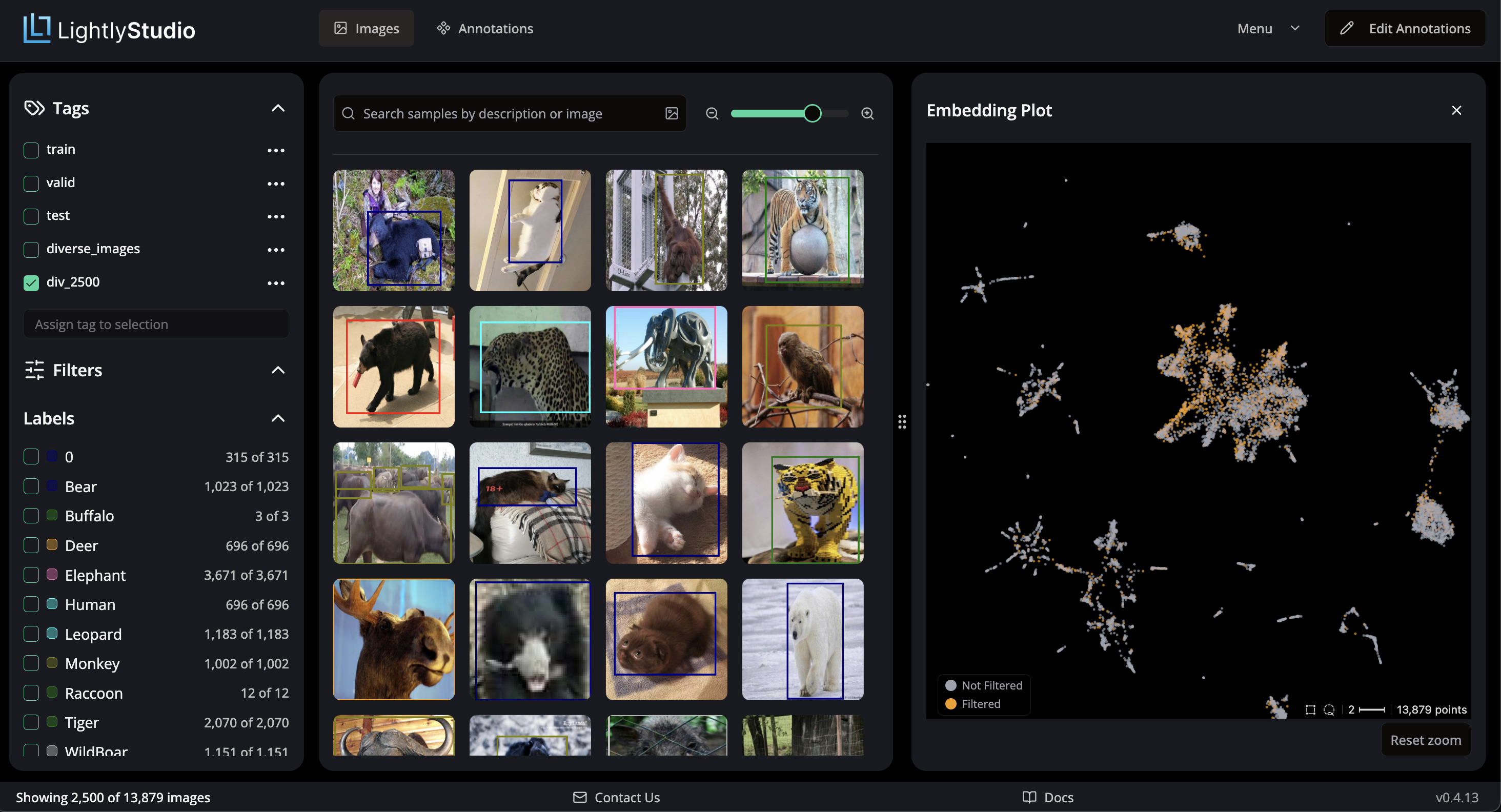
Lightly is a Swiss ML infrastructure company spun out of ETH Zurich. Most Encord alternatives compete on annotation tooling alone; Lightly treats labeling and pretraining as one connected loop. LightlyStudio is an open-source labeling and curation platform — built in Rust, runs COCO or ImageNet on a laptop, supports images, video, audio, text, and DICOM with bounding boxes, polygons, masks, and keypoints. Embeddings, diversity sampling, and active learning surface the samples worth labeling. LightlyTrain pretrains DINOv2/v3 foundation models on your unlabeled data and fine-tunes YOLO, RT-DETR, or ViT for detection, segmentation, and edge deployment.
- Strengths: Open-source core, embedding-based curation, self-supervised pretraining on your own data, on-prem deployment, published migration paths from Encord, Voxel51, V7, Roboflow, and Ultralytics.
- Weakness: Smaller managed-workforce surface than Encord. Teams needing a large external annotator pool inside one platform will pair Lightly with a workforce provider.
- Best for: ML engineers and data scientists with abundant unlabeled data and a constrained labeling budget who want curation and pretraining built into the labeling tool.
💡 Pro Tip: If you're weighing a curation-first stack against a labeling-first one, the 10 Best Voxel51 Alternatives in 2026 walks through that decision in more depth.
2. Voxel51 (FiftyOne)
Voxel51 and its flagship open-source project FiftyOne are the curation-and-evaluation counterpart to Encord. Where Encord leads with annotation, Voxel51 leads with dataset visualization and embedding-based exploration. FiftyOne has over 2.8 million open-source installs and customers including Walmart, GM, Bosch, and Medtronic.
Strengths: strong dataset curation, model evaluation, and visualization. Open-source core. Excellent for finding labeling errors and identifying class imbalance.
Weakness: While FiftyOne now offers capable native in-app annotation for 2D/3D labels (bounding boxes, cuboids, classifications, and interactive segmentation), it is optimized for ad-hoc editing, QA, and refinement rather than high-volume production labeling. For large-scale annotation projects, most teams still integrate it with dedicated tools like CVAT or Label Studio. The Python-first SDK can still create some friction for non-technical labelers. FiftyOne Enterprise is commercial and licensing costs can be meaningful at scale.
Best for: research-leaning ML teams who already have a labeling tool and want best-in-class dataset introspection.

💡 Pro Tip: For a full side-by-side on curation tooling, see The 10 Best Voxel51 Alternatives in 2026.
3. Labelbox
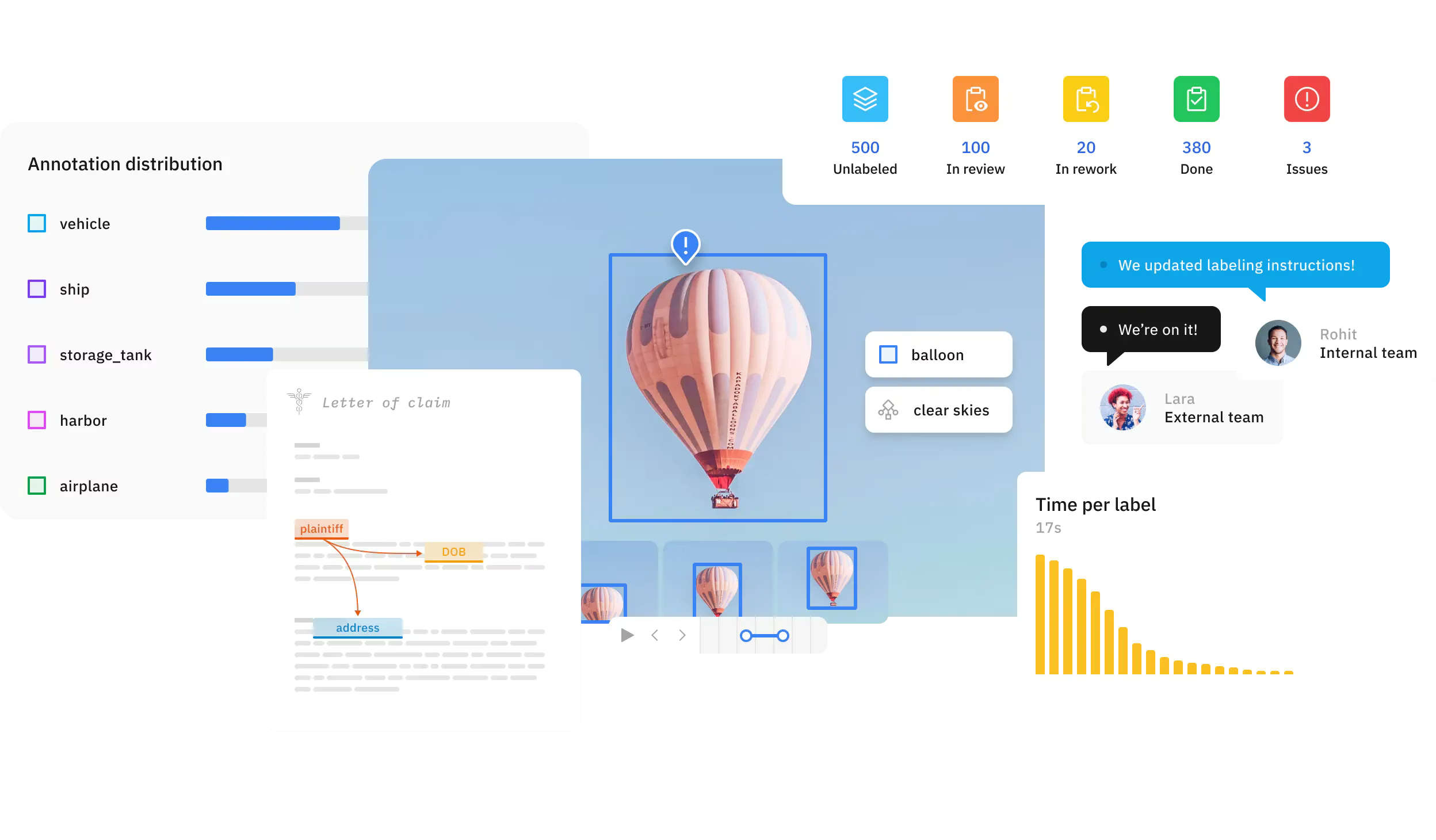
Labelbox is a leading data-centric AI platform. It is a cloud-first SaaS labeling platform with strong annotation tools, dataset versioning, active learning support, model assisted labeling, and consensus-based QA. Labelbox supports image labeling, image annotation, video work, text, and geospatial data with a mature API and SDK; customers can monitor model predictions and surface labeling errors through analytics. Its annotation capabilities span bounding boxes, polygons, segmentation, and object tracking. Pricing starts around $160/user/month on the Growth tier — note that per-seat pricing scales poorly with large external labeling teams.
In 2026 Labelbox added Alignerr, an integrated network of over 1 million vetted subject-matter experts for teams that want a managed-workforce option without leaving the platform.
Strengths: experiment-driven workflows, mature SDK, native active learning, model assisted labeling, consensus-based QA. Strong for teams with existing in-house labeling workforce. Privacy and security informed by SOC 2, ISO 27001, and GDPR.
Weakness: annotation-centric. Curation and evaluation features aren't as deep as Encord's Index/Active or Voxel51 and Lightly. MAL "70% time reduction" claims hold on clean product photography, not surgical video.
Best for: cloud-native enterprise AI teams with existing labeling workforce and complex review workflows.
💡 Pro Tip: Curating with embeddings before sending images to Labelbox typically cuts label volume by 40–60%. See LightlyStudio for the open-source curation layer.
4. SuperAnnotate
SuperAnnotate is in the same neighborhood as Encord and Labelbox: a full image annotation tool and labeling platform with managed workforce options, comprehensive annotation tools, and QA dashboards. SuperAnnotate is often ranked #1 for ease of use on G2. It supports image video work, text, audio, and LiDAR with workflow management for distributed annotation teams handling multiple annotation types in parallel.
Strengths: QA dashboards, role-based user management, integrated workforce, quality control features, integration with training pipelines. Marketplace-style annotator network. Handles bounding boxes polygons, polylines, keypoints, segmentation, and full image annotation services.
Weakness: annotation-centric. Dataset curation and model evaluation are lighter than Encord's Active. Tool-first — teams look beyond it for broader modality support and enterprise compliance.
Best for: teams whose annotation volume exceeds in-house capacity, with a mix of internal and external labelers under one platform.

💡 Pro Tip: Pairing SuperAnnotate with a curation layer means human reviewers only see the samples that matter. LightlyStudio does this open-source.
5. Scale AI
Scale AI is the market reference point for enterprise annotation tools, especially in autonomous vehicles, defense, and large-scale RLHF for foundation model training. The Scale Data Engine covers multi sensor annotation across image video data, 3D LiDAR point cloud, text, audio, RLHF data collection, and evaluation services. Their separate dataset management product, Nucleus, handles curation and model performance analysis. Scale's image annotation tool is mature for labeling objects across multi sensor data, and the company has been a top choice for autonomous vehicles programs offering data labeling services to government clients.
Two things to know before evaluating Scale in 2026.
First, Meta acquired a 49% stake in Scale AI in 2025 in a deal valued at approximately $14.3 billion. Some former customers have moved away citing competitive concerns. If your company competes with Meta directly, this is worth a procurement-level conversation.
Second, Remotasks, Scale's crowdwork platform, has been the subject of repeated investigative reporting on worker pay and conditions — covered by Time, The Guardian, and MIT Technology Review between 2023 and 2025.
Strengths: unmatched scale, mature multi sensor (LiDAR + camera) annotation for autonomous vehicles, sophisticated quality control features, RLHF as a first-class product. Best data labeling service provider for very large enterprise programs.
Weakness: opaque pricing, high minimum commitments, Meta concentration risk, worker-treatment scrutiny.
Best for: autonomous vehicles programs, defense contractors, and large enterprises that need a fully managed data labeling services platform rather than a tool.

💡 Pro Tip: Teams looking for a self-hostable alternative to Scale's managed model often shortlist LightlyStudio plus a workforce provider of their choice.
6. V7 (Darwin)
V7 has carved out a specific reputation: fast, high-quality image video labeling and medical imaging. V7 Darwin supports image labeling, DICOM, and WSI (whole-slide imaging), with AI assisted labeling, interpolation, and object tracking that's well-tuned for complex segmentation. Segmentation is important for various machine learning applications, including medical imaging and autonomous driving.
V7 also added Workflows — a workflow automation layer that lets teams compose labeling, review, and ML-assisted steps into reproducible pipelines. Model Foundry uses foundation models to automate pre-labeling.
Strengths: best-in-class video segmentation, strong medical imaging support, solid workflow automation. Native DICOM and NIfTI handling.
Weakness: commercial only with no open-source core. Curation is growing but doesn't match Encord Active or Voxel51 for embedding-based introspection. Pricing geared toward enterprise.
Best for: healthcare imaging teams, life sciences, and organizations where segmentation quality on complex structures is the main constraint.

7. CVAT
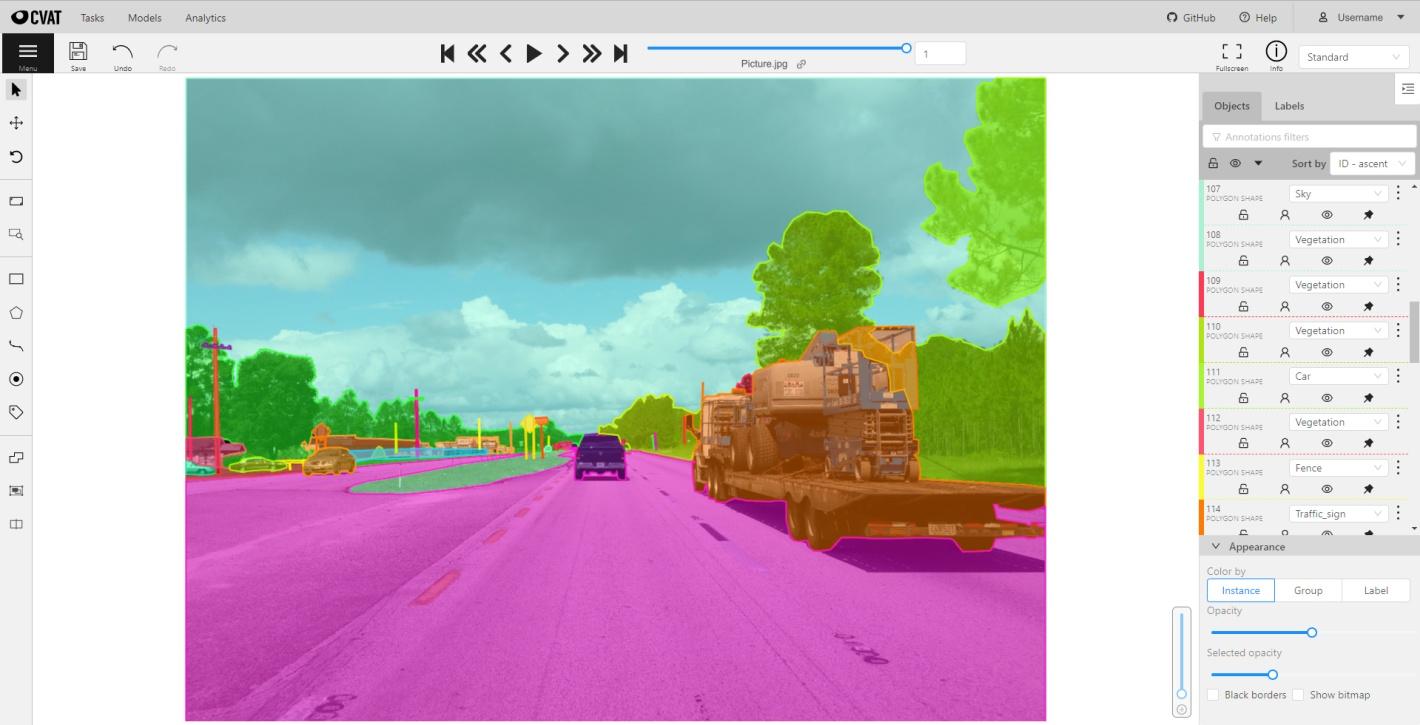
CVAT (Computer Vision Annotation Tool) is the heavyweight open-source image annotation tool. Originally built by Intel, now an independent project, CVAT is the most popular open-source tool for vision, supporting nearly every annotation type. It handles image labeling, image annotation, classification, object detection models, object tracking, pose estimation, 3D point cloud annotation, and segmentation across many annotation types. The CVAT.ai cloud version added integrated AI tools (SAM 2/3, YOLO) for 10x faster automated annotation. Enterprise self-hosting includes SSO, audit logs, and role-based access.
Strengths: free, self-hostable, widest annotation task coverage of any open-source labeling tool, deep integration with ML pipelines, automated labeling.
Weakness: labeling tool first. Curation, embedding-based search, and model evaluation are handled by the surrounding ecosystem. Multi sensor capabilities for autonomous vehicles are limited compared to dedicated AV platforms.
Best for: research teams, academic projects, and privacy-sensitive organizations that need on-prem.
💡 Pro Tip: For curation, evaluation, and managed-workforce alternatives that pair well with CVAT, see 8 Best CVAT Alternatives for Computer Vision Teams in 2026.
8. Label Studio
Label Studio is the most flexible open-source option for multimodal projects. Label Studio is multimodal annotation from the ground up: text, images, audio, video, time series, and structured data all use the same labeling framework. Its annotation tools handle many annotation types across modalities. The Community Edition is free forever; Enterprise adds SSO, workflow management, and support. It supports several annotation types including bounding boxes polygons, classification, named entity recognition, sentiment analysis, and data classification for text data.
Strengths: native multimodal annotation, flexible labeling workflows, free open-source core, strong integration with ML frameworks. Excellent for sentiment analysis, data classification, and text annotation alongside computer vision.
Weakness: for pure high-volume video annotation or 3D point cloud workflows, more specialized tools (CVAT, V7, Encord) feel more native.
Best for: ML teams with mixed modalities, especially those building generative AI and multimodal foundation models alongside computer vision models.

💡 Pro Tip: For computer vision teams that also need embedding-based curation on top of Label Studio's annotation, see LightlyStudio.
9. Roboflow
Roboflow has a different center of gravity than Encord. It covers data sourcing, image labeling and augmentation, model training, and hosted or edge deployment in one pipeline. Roboflow offers a generous free tier for public datasets and is a fast way to get from raw images to a trained model — particularly popular for YOLO-based object detection models. For small annotation projects, Roboflow's image annotation tool delivers training data faster than enterprise platforms.
Roboflow Universe hosts tens of thousands of public datasets, and its labeling tool ships with SAM-based AI assisted labeling. Roboflow does not handle multi sensor LiDAR workflows for autonomous vehicles.
Strengths: fast time-to-deployed-model, integration across the computer vision pipeline, automation-first labeling workflows. Strong for image classification and detection projects.
Weakness: cloud-first. Strict data-residency or on-prem requirements are a blocker. Curation tooling lighter than Encord's.
Best for: startups, solo developers, and applied computer vision teams that want an end-to-end stack.

💡 Pro Tip: For teams considering Roboflow specifically for YOLO training but wanting a stronger pretraining story, see Best Ultralytics Alternatives in 2026 and LightlyTrain.
10. Kili Technology
Kili Technology is a France-based ai data platform that's a credible Encord-tier option, especially for European teams and workflows that mix vision with document and NLP annotation. Kili's image annotation tool supports image annotation, video annotation, text, PDFs, and geospatial data, with AI assisted labeling, 95%-accuracy QA workflows, and SOC 2 / ISO 27001 / HIPAA compliance. For teams training machine learning models on document data alongside images, Kili offers strong image annotation services and data curation in one platform.
Strengths: EU-based data residency, transparent pricing, strong document and NLP annotation alongside computer vision, comprehensive quality assurance tools.
Weakness: smaller installed base than Encord, and curation features don't match Encord Active for embedding-based analysis.
Best for: European enterprises, document-heavy AI workflows, and teams blending computer vision with NLP annotation.

💡 Pro Tip: EU teams that need data residency and self-supervised pretraining on their own data should also evaluate LightlyTrain, which is also EU-hosted, with on-prem deployment.
Honorable mention: Dataloop and AV-specialist tools
Worth naming briefly for completeness. Dataloop is an end-to-end image video labeling platform with strong automation and Python-SDK-driven data workflows. Dataloop operates on an on-demand pricing model, providing flexibility for users based on their specific needs. For autonomous vehicles and robotics teams specifically, Mindkosh and Segments.ai offer purpose-built multi sensor fusion (LiDAR + multi sensor camera) labeling that goes deeper than general-purpose tools on point cloud and sequential sensor data
How to choose
Feature checklists are easy to write and easy to ignore. Four questions decide most procurements: where does your data live, what's your actual bottleneck (labeling, curation, or training), how many people need to be in the tool, and what modalities will you need 12 months from now. Most platforms on this list are strong at one thing and adequate at the rest — picking the wrong center of gravity is the most expensive mistake you can make here.
Name your bottleneck out loud, then pick:
- Lots of unlabeled images, small labeled set. Lightly — LightlyStudio for curation, LightlyTrain for pretraining.
- You suspect your labels are the problem. Voxel51 (FiftyOne) or Lightly for embedding-based error surfacing.
- You already have a labeling team and need to scale them. Labelbox or SuperAnnotate.
- You need a managed workforce at AV or RLHF scale. Scale AI, with the Meta-stake caveat noted earlier.
- Medical imaging or hard video segmentation. V7 (Darwin).
- Self-hosted, open source, vision-heavy. CVAT.
- Mixed modalities in one tool — text, image, audio, video. Label Studio.
- End-to-end YOLO pipeline, fast. Roboflow.
- EU residency plus documents + computer vision. Kili Technology.
One last thing: every tool here will demo well. Tool fit shows up in week two, on your own data, with your own annotators. Run the top two on a representative slice before you commit.
Final thoughts
Encord built something genuinely useful, and remains a strong default for many enterprise AI teams. But "default" and "best for you" are not the same. The data labeling platform and curation landscape in 2026 is more crowded than it was a year ago. The Meta-Scale deal pushed teams to rethink vendor concentration, and open-source data management and curation tools paired with self-supervised pretraining have given smaller teams a credible way to compete on data quality. Modern annotation tools now wrap labeling, curation, model validation, and evaluation into integrated workflows that close the gap between data and computer vision models.
The right Encord alternative depends on whether your real problem is annotation throughput, dataset curation, model training, or model evaluation. Pick two or three that match your bottleneck, run them on a real slice of your data, and let the results decide.
Stay ahead in computer vision
Get exclusive insights, tips, and updates from the Lightly.ai team.

.png)
.png)